

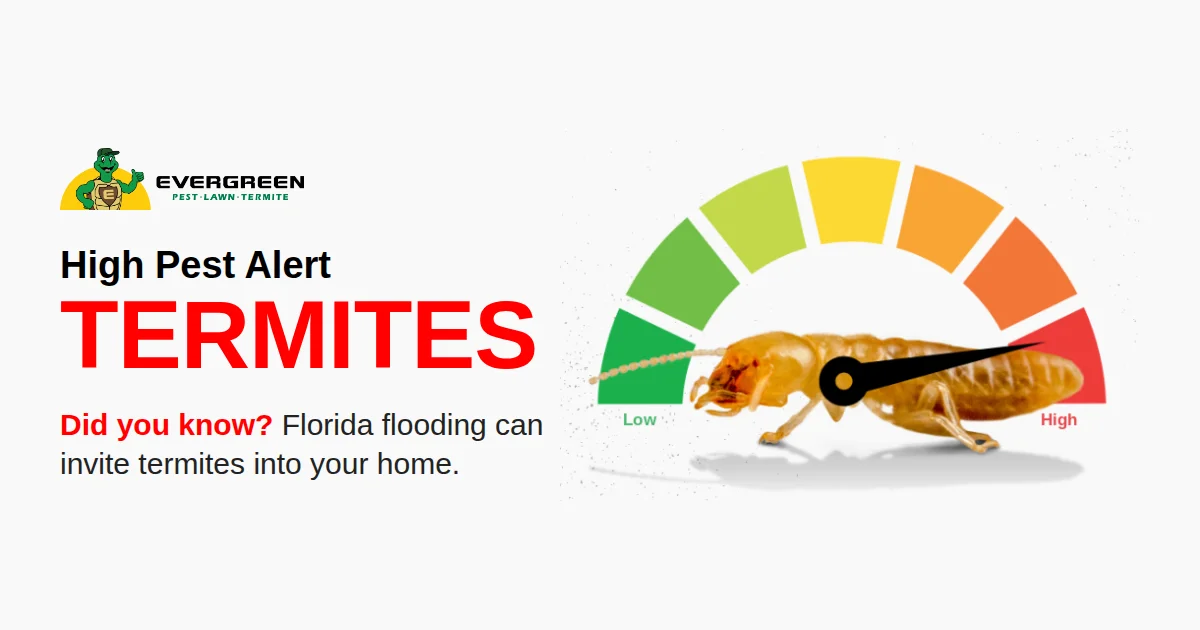
The short answer: Yes. Flooding can make your home more attractive to subterranean termites. These termites need moisture to survive and readily feed on water-damaged wood, so saturated soil and damp wood around a foundation give them exactly what they're looking for. If water pooled around your home this season, clear away debris, let the area dry out, and schedule a termite inspection.
Did you know?
- One colony can sprawl under your whole yard. The Florida Department of Agriculture and Consumer Services (FDACS) says a single subterranean colony can spread across an acre beneath a home.
- Invasive termites are spreading statewide. A 2026 University of Florida study found Formosan and Asian subterranean termites have spread well beyond South Florida.
- They can slip through a crack as thin as a credit card, according to FDACS.
- Most people find out too late. The EPA says most homeowners don't realize they have termites until they see a swarm or find damage.
- Your mulch could be helping them. UF/IFAS recommends keeping mulch thin near the foundation so the soil can dry.
Why does flooding raise the risk right now?
Florida just lived through what forecasters are calling a once-in-a-thousand-year weather event. But the termite risk that follows heavy rain isn't limited to one region. Wherever water has pooled around a foundation in Florida this season, the same problem applies.
Days of standing water around foundations leave the soil soaked and wood damp. Those are exactly the conditions subterranean termites need to thrive. An urban entomologist at the UF/IFAS Fort Lauderdale Research and Education Center points out that flooding often leaves moisture problems behind, that subterranean termites readily feed on water-damaged wood, and that controlling moisture after a storm is key to preventing an infestation.
Did you know termites need moisture to survive?
Yes. Subterranean termites live in large underground colonies and dry out quickly in open air. To survive, they need two things: moisture and cellulose, the material found in wood, leaves, mulch, and paper.
After heavy flooding, homes can check both boxes at once:
- Saturated soil next to the foundation lets termites forage closer to the surface and closer to your home.
- Wet or water-damaged wood in siding, door frames, fences, decks, and crawl spaces is softer and easier to eat.
- Flood debris like fallen branches, soaked cardboard, and wet mulch piles gives colonies a food source right up against the house.
- Hidden leaks and poor drainage that the storm exposed or created keep moisture trapped long after the yard looks dry.
Florida is home to native Eastern subterranean termites and two invasive species, the Formosan and Asian subterranean termites. A February 2026 University of Florida study found both invasive species have spread well beyond South Florida. Asian subterranean termites are now established as far north as Brevard and Hillsborough counties, and Formosan termites are established in most coastal counties and large cities statewide. You can see how far they've spread on the UF/IFAS Florida termite distribution map.
These aren't minor pests. According to FDACS, subterranean termites cause more damage worldwide than any other termite type, and the most damaging groups include the Formosan, Asian, and Eastern subterranean termites, all found in Florida. They live in the soil and invade homes from underground.
How can you tell if you have termites?
Look for wings, mud tubes, and damaged wood, but don't rely on spotting them yourself. Most homeowners never see a termite until there's already a problem. Keep an eye out for:
- Discarded wings near windowsills, doors, or light fixtures. Swarmers shed their wings after they find a mate, and these piles are often the first clue.
- Mud tubes about the width of a pencil running up foundation walls, piers, or slab edges.
- Hollow-sounding or soft wood when you tap baseboards, door frames, or trim.
- Bubbling or uneven paint that can look like water damage, which makes it easy to miss after a flood.
- Doors and windows that suddenly stick, since termite activity and moisture can both warp frames.
Don't count on spotting them yourself. The EPA notes that most people don't realize they have termites until they see a swarm or find damage, and UF researchers say subterranean termites are hard to detect without regular professional inspections.
What should you do after a flood?
Dry out the area around your foundation, close off entry points, and get a professional inspection. These steps follow guidance from FDACS, UF/IFAS, and the EPA:
- Clear flood debris away from the foundation, including branches, wet cardboard, and soaked firewood. The EPA advises against piling firewood or wood debris next to the house.
- Extend gutters and downspouts. FDACS recommends extending gutter and drainage systems at least 1 foot away from your home to reduce moisture, and the EPA recommends grading so water drains away from the foundation.
- Fix leaks right away and aim sprinklers away from walls. FDACS advises repairing water leaks in or around your home immediately, and UF/IFAS notes that irrigation hitting walls is a conducive condition.
- Keep mulch and plants off the foundation. FDACS recommends keeping mulch and plant material away from your home's exterior, and UF/IFAS suggests mulch under 2 inches deep within 12 inches of the foundation, with about a 6-inch inspection gap below siding.
- Seal cracks in the foundation and exterior. Termites can use a crack as thin as a credit card to get in, according to FDACS.
- Get an annual inspection from a licensed pest control company. FDACS recommends a yearly professional inspection, and once your home is treated, avoid disturbing the treatment around your foundation.
How does Evergreen protect your home?
Evergreen uses termite bait systems, a targeted approach that works with how termites behave. According to the EPA, bait systems were introduced in part to reduce overall insecticide use, and they rely on cellulose bait containing a slow-acting insecticide.
An in-ground bait system installed by a licensed pest control company is one of the two professional treatments FDACS recommends for all subterranean termite species, along with a non-repellent chemical soil barrier.
- Inspection: We walk your property and look for activity and conducive conditions like moisture, wood-to-soil contact, and debris.
- Installation: We place bait stations in the soil around your home's perimeter, where foraging termites will find them.
- Elimination: Worker termites feed on the bait and carry it back to the colony, where it's shared and can bring the colony down over time.
- Monitoring: We check your stations on a regular schedule and keep them stocked, so your home stays protected year after year.
Don't wait for the swarm
The best time to stop termites is before they find your home. Call or schedule your termite inspection online and we'll help you dry out, clean up, and stay protected.
Sources
- Subterranean Termites, Florida Department of Agriculture and Consumer Services
- UF/IFAS expert shares pest control tips for hurricane season, UF/IFAS News, September 2024
- New study shows invasive termites threatening homes in Florida are spreading farther than predicted, University of Florida News, February 2026
- Florida termite distribution map, UF/IFAS Fort Lauderdale Research and Education Center
- The Facts About Termites and Mulch, UF/IFAS Extension publication ENY-832, revised June 2023
- Termites: How to Identify and Control Them, U.S. Environmental Protection Agency, updated October 2026
Publishing notes (remove before posting)
- Target keywords: termites after flooding, Florida termite control, Formosan termites Florida, subterranean termites Florida, termite bait system, termite inspection near me
- Suggested URL: /blog/did-you-know-flooding-attracts-termites
- Suggested meta description: Did you know flooding can attract termites? Saturated soil and water-damaged wood give subterranean termites what they need. Here's what Florida homeowners should do now.
- Images: termite gauge graphic from the email header; a photo of a bait station being installed; a mud tube on a foundation
- Internal links: termite service page, free inspection form, any existing "conducive conditions" or moisture content
- Before publishing: confirm the fine print matches the service agreement, and replace the phone number and inspection link
- Answer-first structure: the "short answer" paragraph sits directly under the title so search engines and AI assistants can lift it as the answer. Each H2 is a question followed by a one-sentence answer. Mark up the H2 questions and their opening answers with FAQPage schema.