

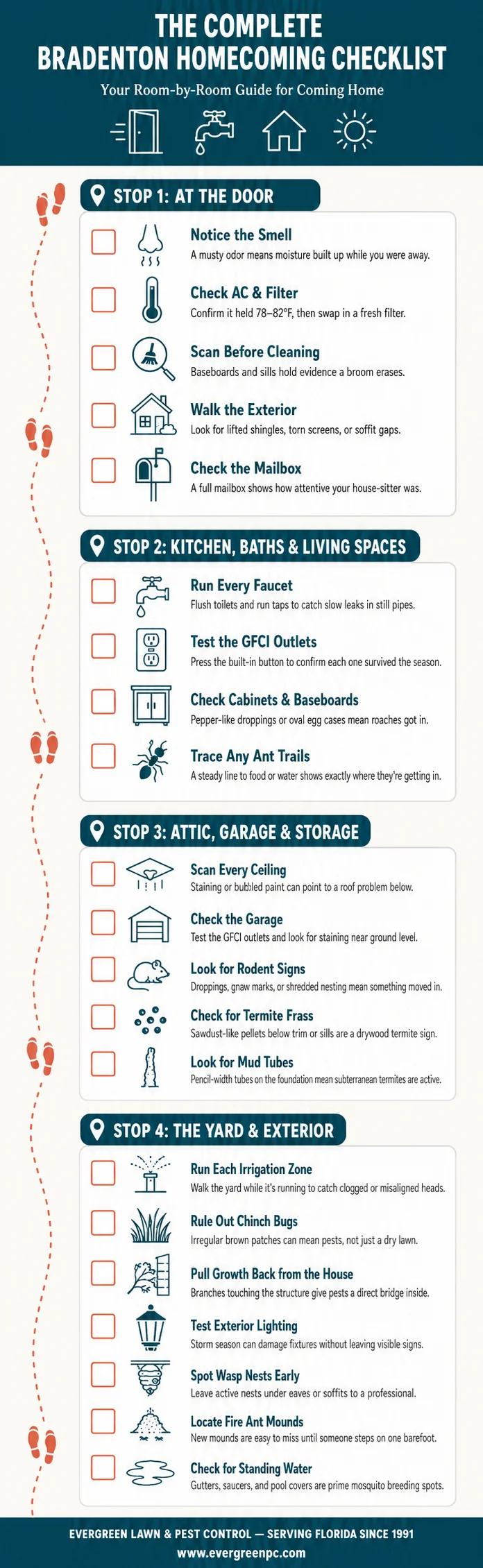
Coming back to your Bradenton property after months away is exciting, but it comes with a quiet worry too: is the house still the same one you left, or did something change while you were gone?
Hurricane season officially runs through the end of November, which means your house was still catching whatever the Gulf sent its way well after most snowbirds had already headed north. Add in a summer's worth of humidity rolling off the Manatee River corridor, and it's fair to wonder how the place actually held up without you.
That's what this guide is built for: a room-by-room walkthrough, starting at the door and ending in the yard, so you know exactly what to look for before you start unpacking. We'll cover your home's systems, the pest evidence worth watching for, and what your lawn needs to bounce back.
Evergreen has served Florida properties since 1991, so we know exactly what a vacant-season Bradenton home goes through every summer.
At the Door
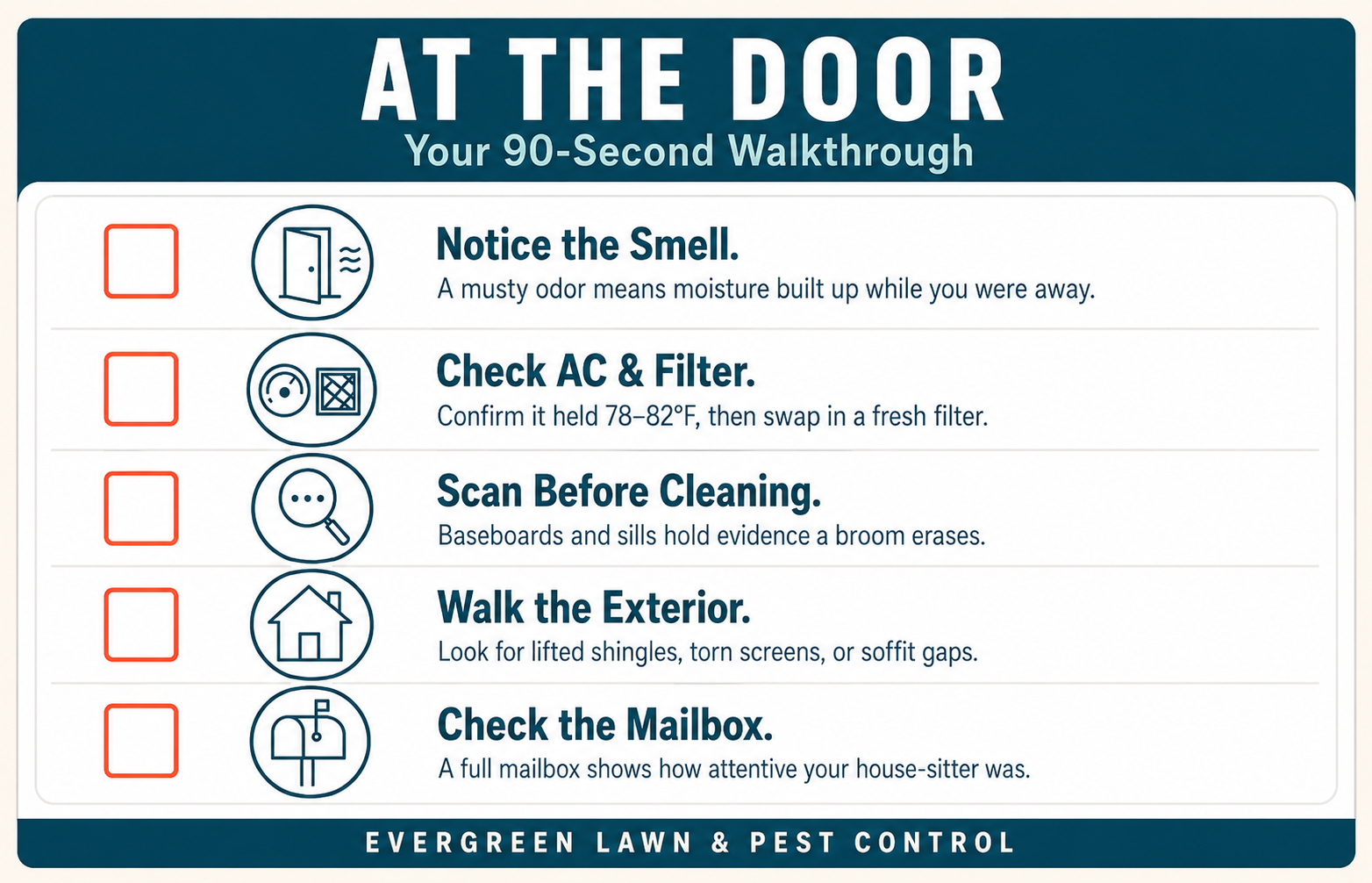
The moment you step inside your home for the first time this season tells you more than you'd think. Take a breath before you do anything else — a musty, closed-up smell means moisture had time to settle in while the house sat empty, and it's the kind of thing you stop noticing within a few minutes of being home.
Next, if you have a smart thermostat, pull up the run history and check that it actually held in the 78-82°F range. This range is where most snowbirds keep their thermostats set to ensure the home’s humidity stays low. While you're focusing on the air conditioning, replace the filter so it continues running at maximum efficiency.
Walk around the interior and take a look at baseboards, windowsills, and countertops. This quick check will show you if any unwanted pests have been moving through the house. It's important to do this before cleaning, as once you've brought out the broom and sponge, you will likely erase any evidence of a potential issue.
Step outside next and walk the perimeter. A quick look around the property tends to turn up whatever a summer of Gulf storms left behind — a lifted shingle, a torn screen, a soffit gap — in about the time it takes to circle the yard.
Before you head back inside, check the mailbox too. If a neighbor or house-sitter was supposed to be keeping an eye on the property, a full mailbox is a quick way to tell how attentive they actually were.
Kitchen, Bathrooms & Living Spaces
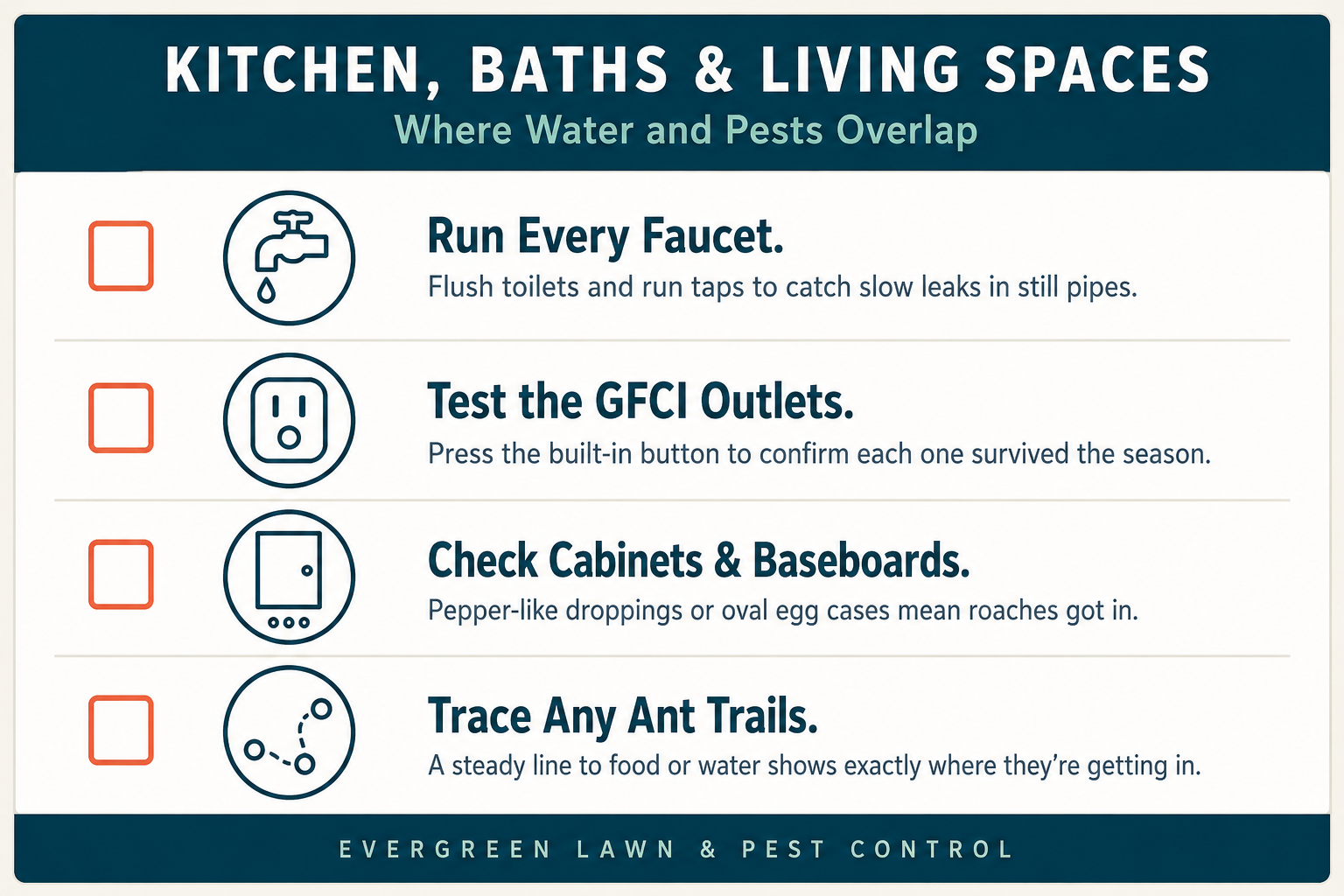
Water that's been sitting untouched for months hides problems you won't find just by looking. Turn on every faucet and flush every toilet before you settle into unpacking. Running water through pipes that have been still all summer is the only real way to catch a slow leak that's been dripping the whole time you were gone. While the water's moving, check under the sinks and around the water heater for staining or pooling, and if the property has a pool or irrigation backflow device, make sure neither was left running, or leaking, in your absence.
The kitchen and bathrooms are also where GFCI outlets tend to be installed, and they're worth a quick test using the built-in buttons on the outlet itself. A summer of storms can affect these circuits even when there's no obvious damage to point to, so a working outlet today isn't a guarantee it made it through the season unaffected — it's just a proof-of-life check for now.
Cockroaches (or palmetto bugs if you grew up in Florida) tend to gravitate toward these same rooms, since sinks and drains give them the moisture they're after. Check baseboards, cabinet hinges, and the space beneath the sink for droppings that resemble ground pepper, and look in cabinet corners for oval, brownish egg cases (called oothecae). If a musty smell lingers inside a cabinet even after you've wiped it down, that's usually your clearest sign something's been living there.
Ants are easier to catch in the act. A single ant crossing the counter isn't much to worry about, but a steady trail heading toward a sink, a pet food bowl, or a stray crumb is worth tracing back to wherever they're actually getting in.
Attic, Garage & Storage
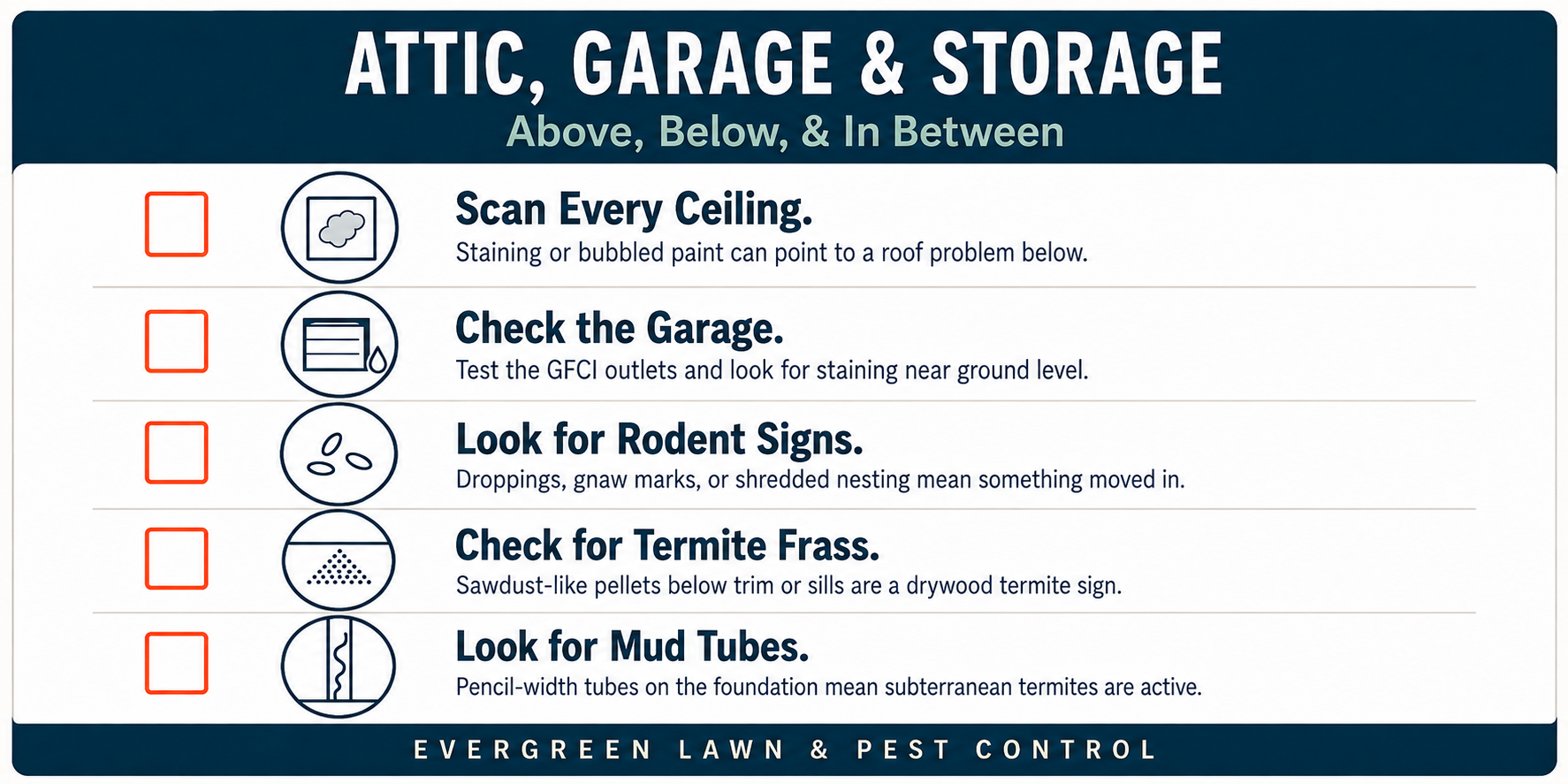
Ceilings can tell you a significant amount about roof problems before anyone climbs up to check the actual roof. Look across every room for new staining, bubbling paint, or soft spots, and if you can safely get up into the attic, take a look at the insulation and roof decking for anything damp. None of these signs guarantees a leak, but they're worth acting on quickly if you spot one — a small issue caught now is far easier to fix than one that's had months to spread.
The garage usually has its own GFCI outlets, and they deserve the same quick test as the ones inside. It's also worth a glance at anything stored near ground level for water staining, since garages tend to flood a little easier than the rest of the house during a heavy season of rain.
Storage areas like these are also where rodents settle in when a house goes quiet for months. Small, dark droppings shaped like grains of rice are usually the giveaway, especially tucked into corners, along baseboards, or inside boxes that haven't been opened. Gnaw marks on cardboard or wiring, and insulation or fabric shredded into a nest, point to the same thing. A stale, ammonia-like smell in a closed-up attic or garage corner can tip you off to the presence of pests, even before you spot anything visible.
Termites are the one pest on this list where timing works against you. Drywood termites leave behind small pellets of frass that look like coarse sawdust, usually below wood trim or on windowsills, while subterranean termites leave narrow, pencil-width mud tubes running up the foundation or support posts instead. Florida's termite swarm season falls in spring, right after most snowbirds have already left for the year, which means an active problem can develop for months with nobody around to catch it early. Between the delayed swarm season and months of nobody watching, termites are worth ruling out on a schedule rather than waiting for visible proof — which is exactly why a termite control checkup soon after you're back is worth booking whether you've spotted anything or not.
The Yard & Exterior
A lawn that's gone months without regular lawn care doesn't fail all at once. Instead, it thins out unevenly, which is actually useful information if you know how to read it. Before doing anything else, it's worth figuring out whether what you're seeing comes from water, pests, or plain neglect, since treating the wrong cause won’t move you any closer to solving the issue.
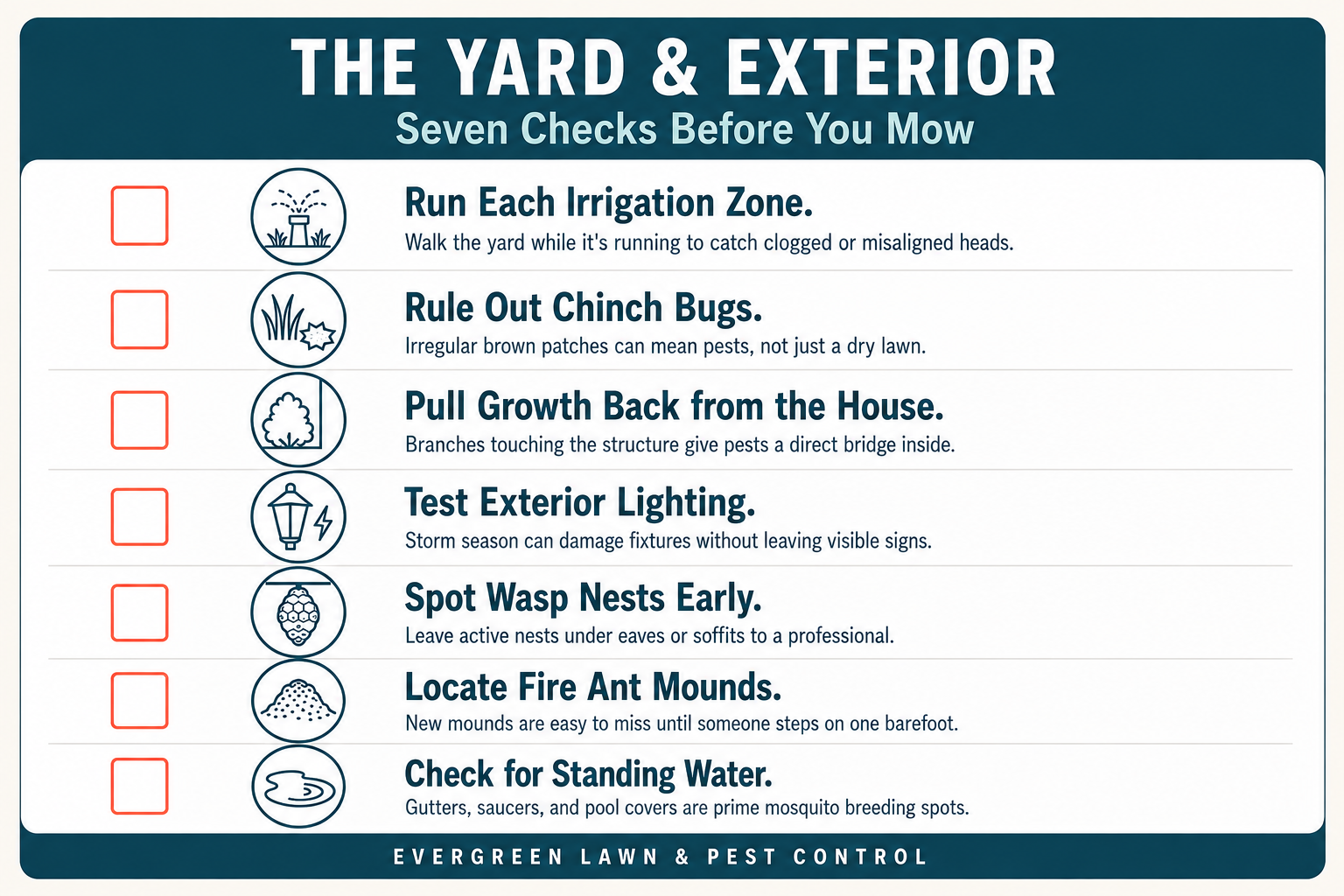
Turn on the sprinklers and walk each zone while they're running instead of guessing from a dry yard. A head that's clogged or knocked out of alignment will starve one section while soaking another. It’s worth it to reset the irrigation timer too, since it's rarely set to anything your lawn actually needs right now, and more likely set to whatever a builder programmed in originally or a house-sitter guessed at months ago.
Not every brown patch is thirsty. Chinch bugs cause the same irregular, spreading discoloration that drought does, but no amount of extra watering will fix a pest problem, so it's worth ruling that out before adjusting your irrigation schedule any further.
Overgrowth matters just as much as the turf itself. Any growth that is close enough to touch the house over the summer (such as a shrub or low branch) gives pests a direct bridge from the yard into the walls, so pulling growth back from the structure is worth doing even if the plant itself still looks healthy.
Exterior electrical fixtures deserve a look as well. A summer of storms and lightning can damage outdoor lighting or overwhelm surge protection without leaving anything obviously broken. For this reason, make sure to confirm everything outside is still working the way it should before you assume it is.
Wasps tend to build in exactly the spots that went untouched all summer — under eaves, inside soffit vents, in porch corners, or tucked into furniture nobody moved. If you spot an active nest somewhere hard to reach, it's best to leave it alone and have it handled professionally rather than risk multiple stings trying to knock it down yourself.
Fire ants are the yard's more literal hazard. New mounds that popped up over the summer are easy to miss until someone steps on one, and a fire ant sting is genuinely painful, so it's worth locating any mounds before anyone walks the yard barefoot.
Mosquito activity is also important to check for, and it’s usually the easiest to trace back to a cause. Walk the property looking for standing water in gutters, plant saucers, pool covers, or anything else that collected rain over the summer. Areas like these where water is standing are highly attractive to mosquitoes, and they breed quickly. If you notice significantly more mosquitoes in your yard than your neighbors’, a mosquito control treatment can target whatever breeding site you missed.
What’s Different About Bradenton
Bradenton's location on the Manatee River changes conditions in ways a lot of homeowners don't expect. Humidity from the estuary stretches well past the immediate riverfront, keeping baseline moisture higher throughout many established neighborhoods than regional forecasts would suggest. That extra moisture doesn't just make the air feel heavier; it speeds up mold growth indoors and stretches the mosquito breeding season past what you'd expect from a typical Florida summer.
The ground itself tells a different story depending on where your property sits. Older neighborhoods on the west side of Bradenton sit on naturally alkaline coastal soil, which makes it harder for St. Augustine grass to pull in the iron and manganese it needs, even in a normal year. A summer with nobody managing irrigation or fertility on top of that can leave the lawn noticeably worse off by the time you're back. Newer development east of town, closer to SR-64 and SR-70, sits on different fill entirely, with its own drainage quirks that create a completely separate set of lawn issues.
That eastward growth brings its own pest angle too. As new subdivisions get built into what used to be farmland around Parrish, the field rodents and fire ants that lived there don't just disappear; they simply move into whatever's built next door. If your home is in one of these newer communities, don’t assume that new construction means pest-free.
When to Consider a Professional
A checklist like this one covers a lot of ground, but it has limits. Some things just aren't visible without training, no matter how carefully you look. That's where a professional pest control and lawn care inspection earns its keep: one visit from a trained technician can confirm what's actually happening and rule out what isn't, in places you'd never think to check on your own.
That kind of read on a property doesn't come from a single season. Instead, it's the kind of judgment you only build after decades of watching what a Florida summer actually does to Bradenton homes. Evergreen backs that experience with free estimates and same-day service whenever scheduling allows, and our Integrated Pest Management approach means we're addressing what's actually causing a problem instead of treating everything the same way. Our bilingual crew is also available depending on your location and technician.
If you're returning to a seasonal home in Bradenton, Parrish, Lakewood Ranch, or anywhere else in Manatee County, call Evergreen at (941) 229-5433 to request a free estimate — or use the checklist you just walked through as your own starting point for what to mention when you call.