

.png.2609020839302.webp)
The first hour back in your Orlando home tends to go the same way for most snowbirds: keys in the door, bags still in the trunk, and one quiet question running underneath the excitement: is everything still the same as when I left?
That question is common for Orlando snowbirds. Central Florida doesn't really take a season off. Between June and October, your property sat through triple-digit heat indexes, near-daily afternoon downpours, and whatever tropical system happened to pass through. Most homes come through that stretch just fine. However, conditions like that don't need long to turn a small issue into a real repair bill.
This Orlando snowbird home checklist follows that same timeline: your first hour, your first day, and your first week home. It covers your home's systems, the pest evidence worth watching for, and what your lawn needs to bounce back.
Evergreen has served Florida properties since 1991, so we know exactly what a vacant-season Orlando home goes through every summer.
The First Hour: Before You Unpack
As exciting as it feels to get back to your property, resist the urge to start hauling suitcases inside or cracking windows to air the place out. The first few minutes back tell you more about how the house actually held up than anything you'll notice once you've settled in and started cleaning.
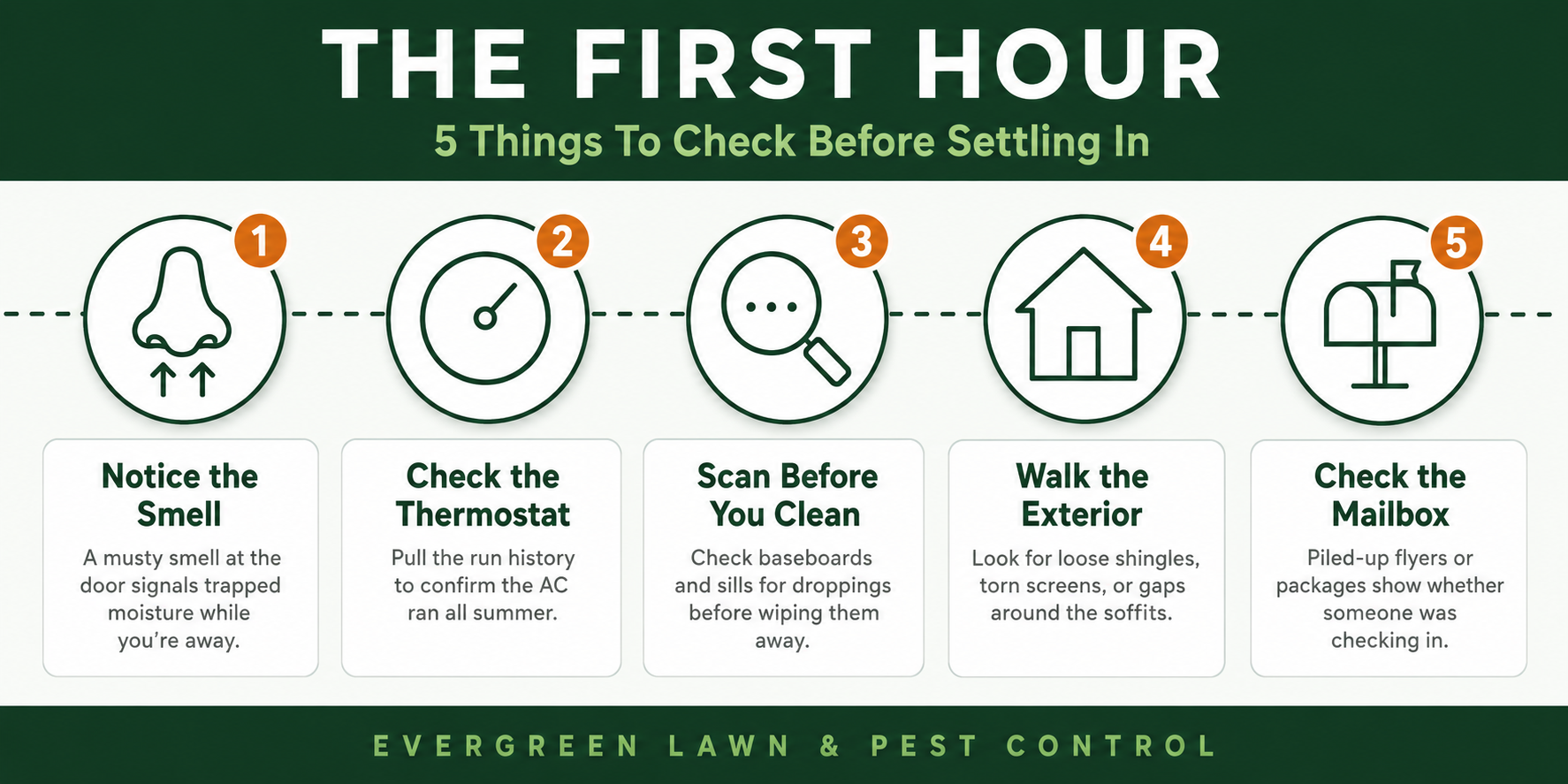
Before you do anything else, take one slow pass through the property and pay attention to:
The air the moment you open the door. A musty or mildew-heavy smell right when you walk in is one of the earliest, most reliable signs that moisture built up somewhere while the house was closed.
Your thermostat's history. If you've got a smart thermostat, pull up the app and check whether the AC actually ran consistently all summer, or whether there are gaps and humidity spikes worth a closer look.
Baseboards, windowsills, and countertops, before you clean them. Droppings, shed insect wings, or dead bugs are easy to wipe away without thinking twice, but they're also the clearest evidence of what's been active in the house.
The exterior. A slow walk around the outside of the home can turn up loose shingles, torn screens, downed branches, or gaps around the soffits that summer storms left behind.
The mailbox and porch. A pile of flyers or packages tells you something too: whether a neighbor, house-sitter, or property manager was actually checking in the way they were supposed to.
The First Day: A Quick Systems Check
The goal of the “Day 1 Walkthrough” is to give the house's major systems a functional check. You're not trying to diagnose anything yourself here, just get a read on whether things are working the way they should before you fall back into your normal routine.
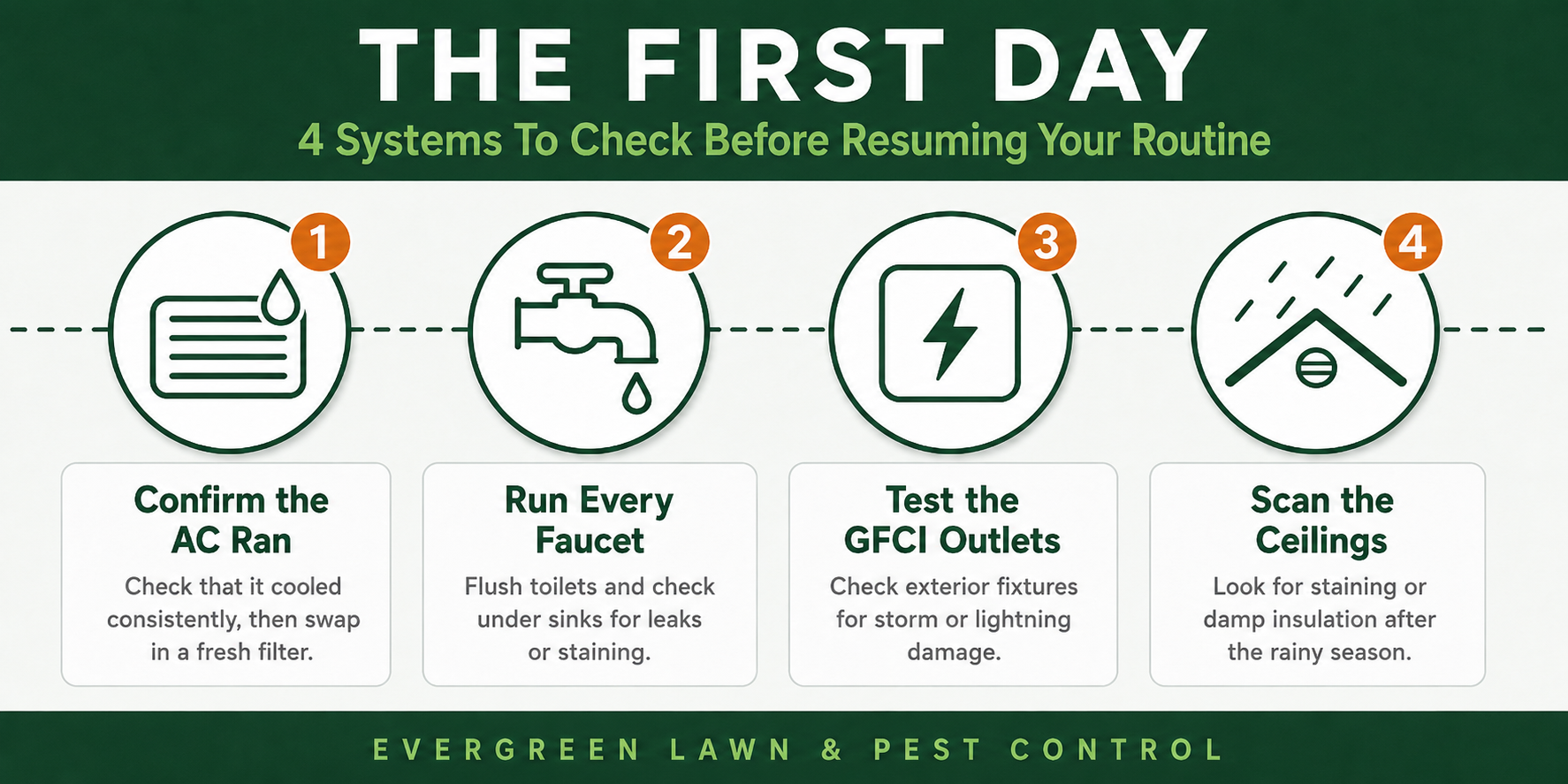
Air Conditioning & Humidity Control
Before you touch the thermostat, pay attention to how the house already feels. If the air seems heavy or slightly damp even with the AC running, that's usually a clear signal of how the system actually held up while the property was vacant.
If you've got a smart thermostat, pull up the run history and see whether the system operated steadily the whole time, or dropped out somewhere along the way. Most snowbirds leave the thermostat in the high 70s to low 80s before heading north, less for comfort and more to keep humidity from building up while no one's home.
From there, swap in a fresh air filter and check behind furniture and inside closets for anything that resembles mold. Then hold your hand near the vents to confirm cool air is actually making it into the room.
If something still feels off after that, an HVAC tech can usually tell within minutes whether it's a simple fix or something that's been developing since summer. Either way, a house that's been quietly losing the humidity battle all season is exactly the kind of environment roaches look for, which is worth keeping in mind once you get to the pest section.
Plumbing
Turn on every faucet in the house and let it run for a minute, then flush every toilet, before you do much else. It's the fastest way to clear stagnant water out of the pipes, and about the only real way to catch a slow leak that's been dripping since summer with no one around to notice.
While the water's running, check underneath sinks and around the water heater for staining, pooling, or a smell that doesn't seem right. If your property has a pool or an irrigation backflow device, take a minute to confirm neither one was left running or leaking while you were away — that's an easy thing for a timer or a house-sitter to miss.
You're not diagnosing anything here, just running the system once and paying attention to what it tells you.
Electrical
Central Florida saw its share of afternoon thunderstorms and lightning while you were gone, and electrical systems don't always show the damage right away.
Test the GFCI outlets in the kitchen, bathrooms, garage, and anywhere outdoors, using their built-in test and reset buttons. Take a look at exterior lights and fixtures for anything resembling storm or water damage, and confirm whatever's plugged into surge protection is still working the way it should.
If a breaker keeps tripping, an outlet looks damaged, or anything smells burnt, that's a job for a licensed electrician rather than something to troubleshoot yourself.
Roof, Attic & Ceilings
Start with the ceilings, since they're the easiest place to catch water damage before it becomes obvious. Look for new staining, bubbling paint, or soft spots, and if you can safely get into the attic, check the insulation and roof decking for dampness.
A roof that just came through a full rainy season with no one home to check for damage is worth checking early, before a small stain turns into a bigger repair. Attics and rooflines are also common entry points for pests, so it's worth noting anything unusual up here while you're already looking.
The First Week: Watching for Signs of Activity
Pests are patient, and a closed-up house gives them months of uninterrupted time to move in without anyone around to notice. That doesn't mean something's wrong — most of what you'll find is minor and easy to address once you know what you're looking at.
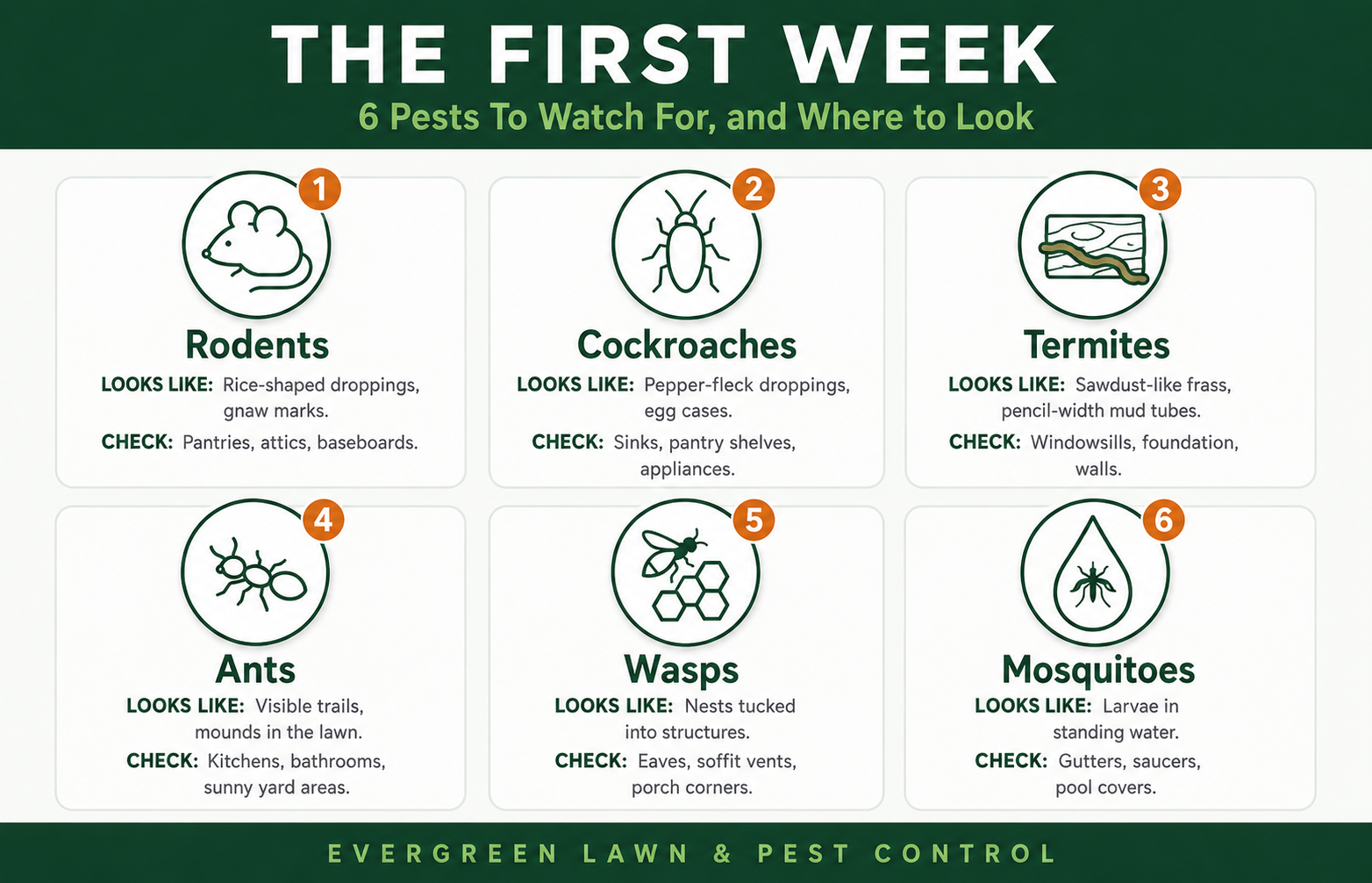
Over your first week back, keep an eye out for the following, room by room.
Rodents
Small, dark droppings shaped like grains of rice are usually the first giveaway, especially in pantries, attics, garages, and along baseboards. Gnaw marks on food packaging, wiring, or baseboards are another sign, along with shredded insulation or fabric gathered up as nesting material. A stale, ammonia-like smell in a closed-up room or the attic can also suggest the presence of rodents, even before you find anything visible.
Cockroaches
In Florida, homeowners often call the larger cockroach species around the house a 'palmetto bug.’ But whether it's a palmetto bug or a smaller variety, the evidence they leave behind looks the same. Look for small, dark droppings that resemble pepper flakes, or smear marks near sinks, baseboards, and pantry shelves. Oval, brownish egg cases (called oothecae) sometimes turn up tucked into cabinet corners or behind appliances. A musty smell inside cabinets that doesn't go away even after cleaning is often the clearest sign something's been living there.
Termites
Drywood termites leave behind tiny, pellet-like frass that looks like coarse sawdust or ground pepper, usually collecting on windowsills or beneath wood trim. Subterranean termites leave a different kind of evidence: narrow, pencil-width mud tubes running up the foundation, exterior walls, or support posts.
Timing matters here more than with most pests. Termites swarm across Central Florida in spring, right after most snowbirds have already headed north for the season. This means an active problem can develop for months with nobody there to catch it early. Because that window falls while most snowbirds are away, it's worth scheduling termite control services soon after you return, even if you haven't spotted frass or mud tubes yourself.
Ants
A few ants wandering across a counter aren't usually a big deal, but a steady trail (especially around sinks or pet food bowls) is worth tracing back to its source. Outside, keep an eye out for fire ant mounds that popped up in the lawn over the summer. Beyond being a nuisance, fire ants are a real safety concern for anyone walking the yard barefoot.
Wasps & Other Stinging Insects
Paper wasps and mud daubers are the most common stinging insects to move in on a home that's sat untouched all summer, and each leaves different evidence. Paper wasps build an open, honeycomb-like cluster you can spot at a glance; mud daubers leave behind small, tube-shaped mud tunnels instead. Check under eaves, inside soffit vents, in porch corners, and around outdoor furniture that hasn't moved in months — grills, patio chairs, and stored umbrellas are common spots.
If you find an active nest, especially somewhere hard to reach, it's best to leave it alone and schedule pest control service rather than risk multiple stings trying to knock it down yourself.
Mosquitoes
Check gutters, plant saucers, pool covers, and anywhere else water could have collected after a summer of Central Florida's near-daily storms. Standing water creates prime breeding grounds for mosquitos. If your yard feels noticeably buggier at dusk than your neighbors', that's usually a sign there's a breeding site nearby that mosquito control can target.
Why Orlando Homes Need a Longer Look
Central Florida doesn't behave like the rest of the state, and Orlando's geography is a big part of why.
Much of the Orlando area sits directly on lakes rather than just near them. Winter Park's named chain of lakes (Lake Virginia, Lake Osceola, and Lake Maitland) runs right through the middle of the city, Kissimmee stretches along the northern shore of Lake Tohopekaliga, and Sanford backs up to Lake Monroe and the St. Johns River. Standing water left unchecked after a summer of near-daily rain turns into ideal environments for mosquitoes almost immediately in any of these areas, and the same damp, shaded yards near water also draw rodents and ants looking for shelter.
The Orlando metro also isn't really one place — it's four counties stitched together, each with its own character. Orange County is the dense urban core, Seminole County to the north is established suburbs, Osceola County to the south has grown quickly around tourism, and Lake County to the west is hillier and more lake-dotted. That shapes what you're walking into: historic, tree-canopied areas like Winter Park and College Park (both in Orange County) come with mature landscaping and older construction, both of which create more gaps and entry points for pests. Newer communities like Lake Nona or Winter Garden have the opposite issue — freshly disturbed soil and young sod that hasn't had time to build up resilience, leaving the lawn more vulnerable to pests and disease while it establishes.
One more thing worth knowing if you're not from here: lovebugs. If your return happens to line up with one of Central Florida's lovebug swarms in spring or late summer, don't read too much into a sudden cloud of them on your car or porch. They're a genuine seasonal nuisance around Orlando, not a sign anything's wrong with the house. Still, they're a good reminder that pest activity in this part of Florida doesn't really follow the calendar the way it might up north.
Bringing the Yard Back to Life
By the time you've worked through the house, the yard is usually the next thing that will clue you in on how the summer actually went. A few months of heat, heavy rain, and no consistent mowing or irrigation oversight is enough to transform a healthy lawn into one that is thin, patchy, or overrun with weeds.
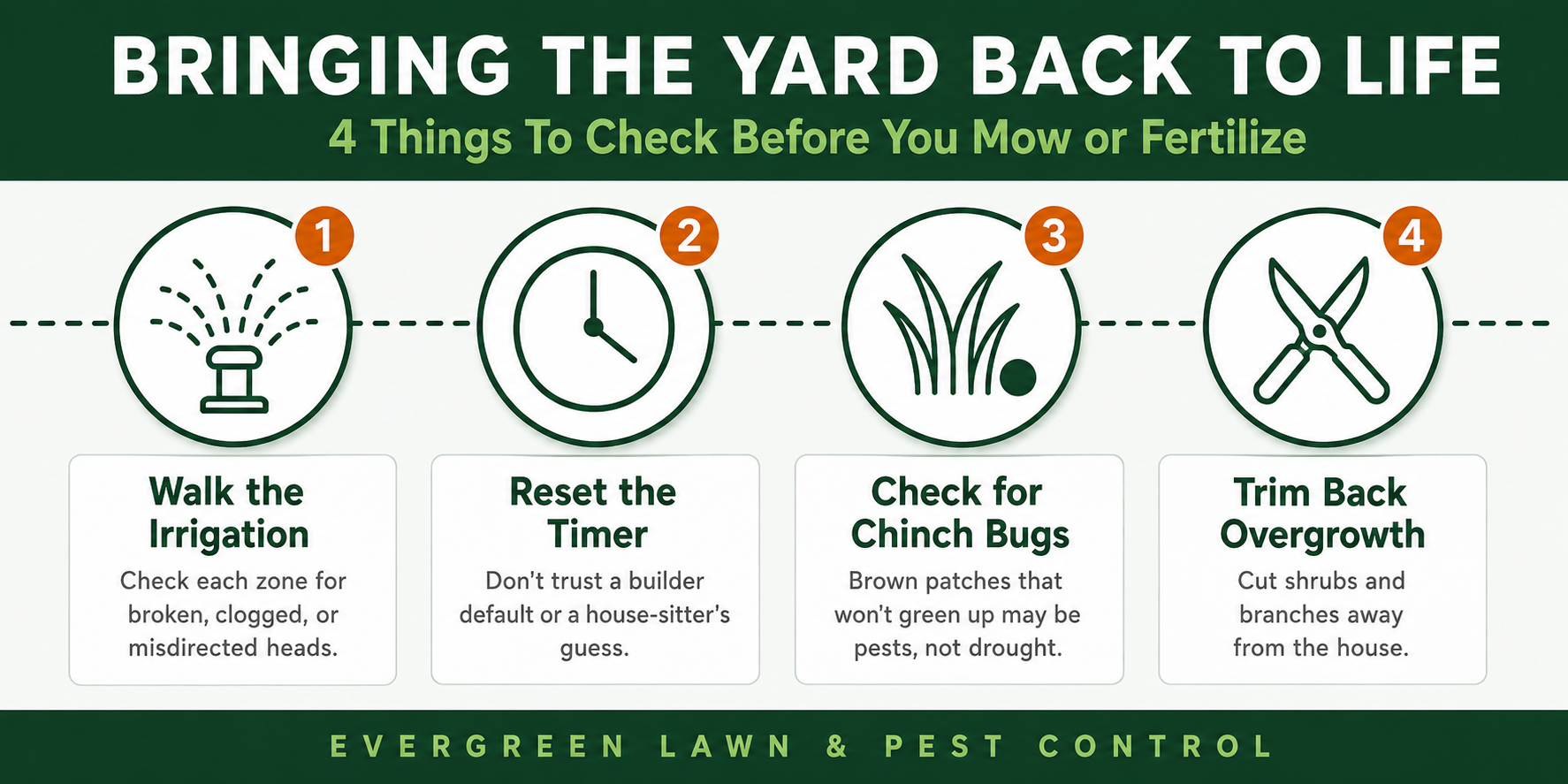
Walk the irrigation system zone by zone while it's running, and look for heads that are broken, clogged, or simply aimed at the wrong part of the yard. It's worth resetting the timer altogether while you're at it. Many times, timers get left on a builder default or whatever schedule a house-sitter guessed at, and neither one reflects what your lawn actually needs right now.
Keep an eye out for chinch bug damage too. Irregular brown patches that don't improve no matter how much you water are usually a sign of chinch bugs, not drought stress, so more watering won't fix it.
Last, trim back any shrubs or tree branches that grew in against the house over the summer. It's easy to put off, but overgrown landscaping touching the structure is one of the simplest ways pests move from the yard into the walls.
If the yard looks significantly different from when you left, a professional lawn care assessment can help sort out what's actually going on.
When to Call a Pro
A few things are hard to fully rule out without training, no matter how carefully you look. That's exactly what a professional pest and lawn inspection is for: one visit from a trained technician can confirm what's actually happening and rule out what isn't, saving you the guesswork and the wasted effort of treating the wrong problem.
Evergreen has served Florida properties since 1991, so our team has spent decades learning exactly what an Orlando home goes through during a long, humid summer with nobody home. We offer free estimates and same-day service when scheduling allows, and our Integrated Pest Management approach means we're addressing the actual cause of a problem rather than treating everything the same way. Bilingual service may also be available depending on your location and technician.
If you're returning to a seasonal home in Apopka, Winter Park, Lake Nona, Kissimmee, Sanford, or anywhere else in the Orlando metro, call Evergreen at (689) 225-1095 for a free estimate.