
Last updated: November 2026. Figures drawn from the cited sources; this page is refreshed as new data becomes available.
Where you live changes what's likely to crawl, fly, or burrow into your home far more than most people assume. Soil composition, winter freeze lines, humidity, and even how a region's homes are built all shape which species establish themselves and how aggressively. A rodent problem in Boston looks nothing like a cockroach problem in Houston, and even within a single state, pest pressure, the species involved, and what treatment costs can shift substantially from one area to the next.
This article brings together national pest data and government risk classifications with independent rankings from sources like Orkin and the University of Florida. Together, they show both what’s true about pest control nationally and what plays out differently across Florida, a state the USDA places in its highest termite risk zone.
What Statistics You’ll Find In This Article
- Why Some Regions Face More Pest Pressure Than Others
- Termite Activity Across Florida
- Common Household Pests: National Data Meets Regional Patterns
- Ants in Florida Homes
- Mosquito Activity and Disease Risk
- What Pest Control Costs
- Pest Control Trends to Watch in 2026
- Frequently Asked Questions
- Methodology
- Sources
Why Some Regions Face More Pest Pressure Than Others
Pest pressure is largely a function of three physical variables working together: soil composition and moisture, the seasonal freeze line that limits how far a cold-sensitive species can survive winter, and how a region builds its homes. Slab-on-grade construction, for example, puts untreated wood framing in far closer contact with termite-friendly soil than a home built over a basement or a raised crawl space in a colder state.
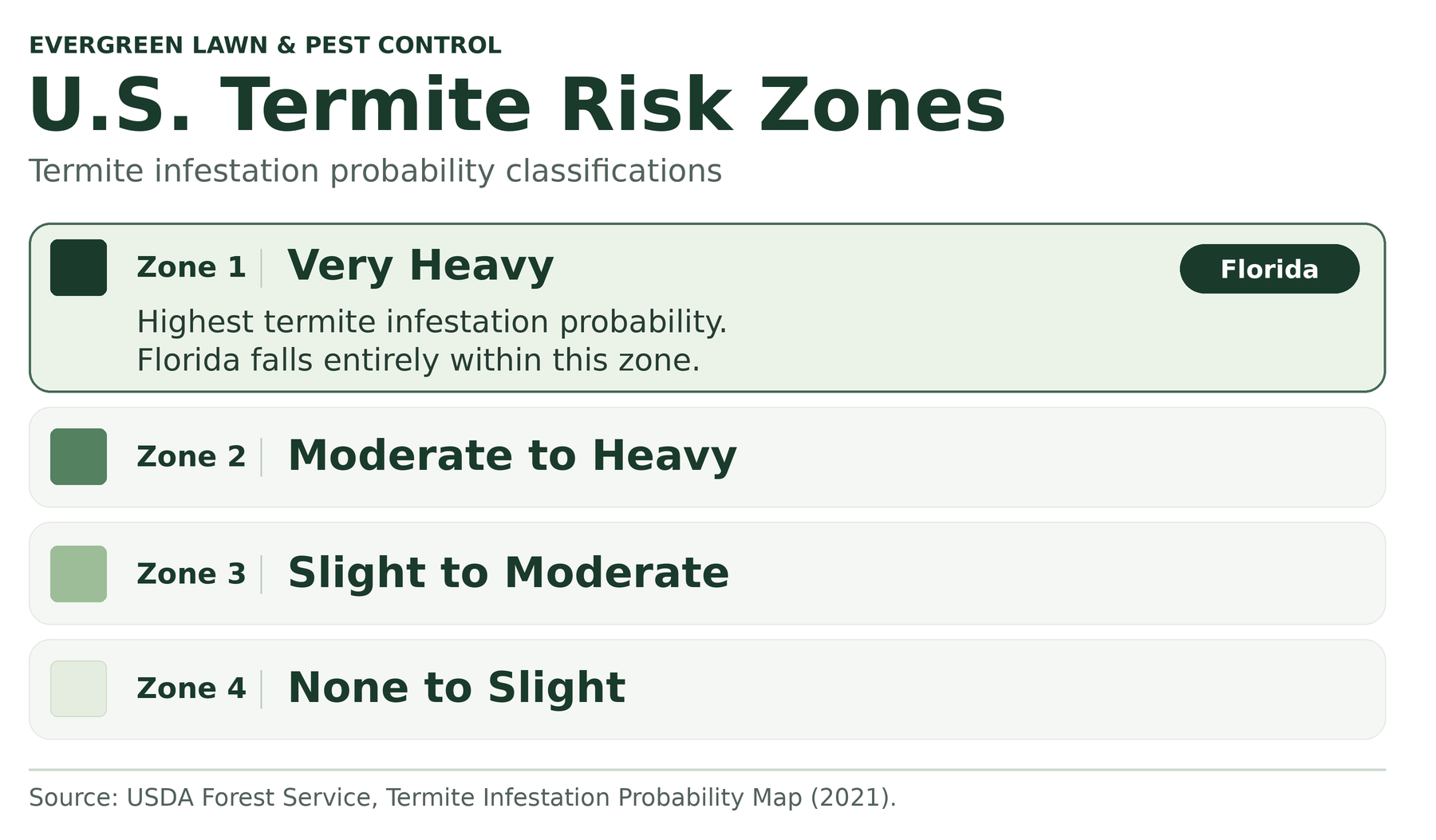
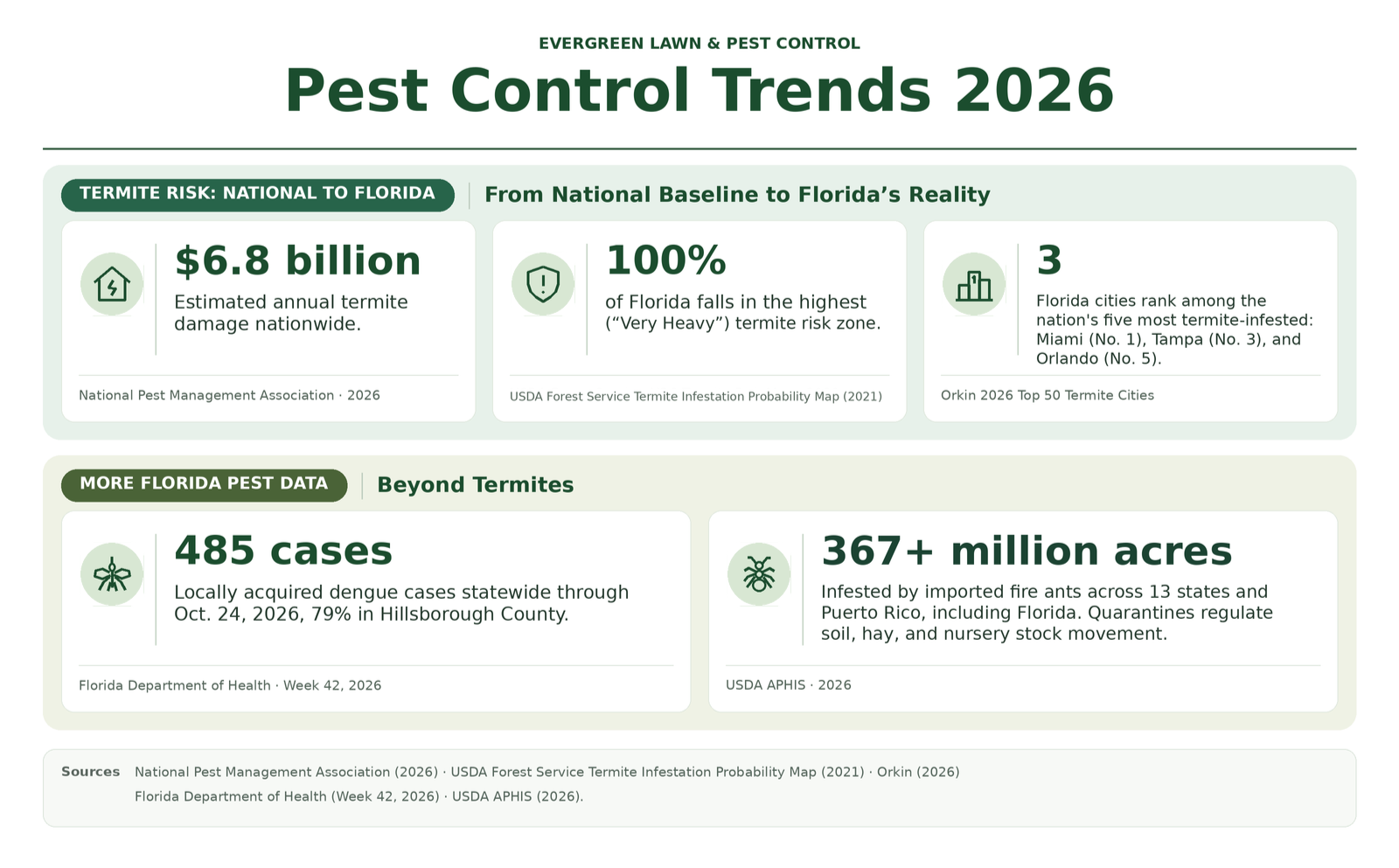
- Florida has “Very Heavy” termite risk: All of Florida falls within Zone 1, the “Very Heavy” termite risk classification, the highest designation on the map (USDA Forest Service Termite Infestation Probability Map, 2021).
- Termites cause an estimated $6.8 billion in property damage across the U.S. every year, and standard homeowners insurance policies almost universally exclude termite damage from coverage (National Pest Management Association, 2026). That gap is part of why prevention and early detection carry so much financial weight in high-risk states.
- Florida’s warm, humid climate supports a great diversity of insects and other arthropods, and entomologists say that on average one new arthropod pest becomes established in the state each month (UF/IFAS, 2014).
- Red imported fire ants infest 367+ million acres across 13 states and Puerto Rico, including Florida, and federal quarantines regulate the movement of soil, hay, and nursery stock out of affected areas (USDA APHIS, 2026).
None of this makes Florida uniquely bad on every pest front. It is especially exposed to termites, which damage structures. Ants and roaches are a different kind of problem, and several Florida ant species are hard to control once established.
Termite Activity Across Florida
Florida’s USDA risk classification sits at the top of the national scale, and the native Eastern subterranean termite (Reticulitermes flavipes) is present statewide (UF/IFAS, EENY-212). Two more destructive invasive species, the Formosan and Asian subterranean termites, have been spreading farther than predicted (UF News, 2026).
A February 2026 University of Florida study found the Asian subterranean termite has already been documented as far north as Brevard County, home to Melbourne, and Hillsborough County, home to Tampa. Researchers now expect it to reach all 24 of Florida’s southernmost counties before 2040. The Formosan termite is already established across most of Florida’s coastal counties and large urban centers, and researchers project it could be found in every county in the state before 2050 (UF News, 2026; Chouvenc et al., Journal of Economic Entomology, 2026).
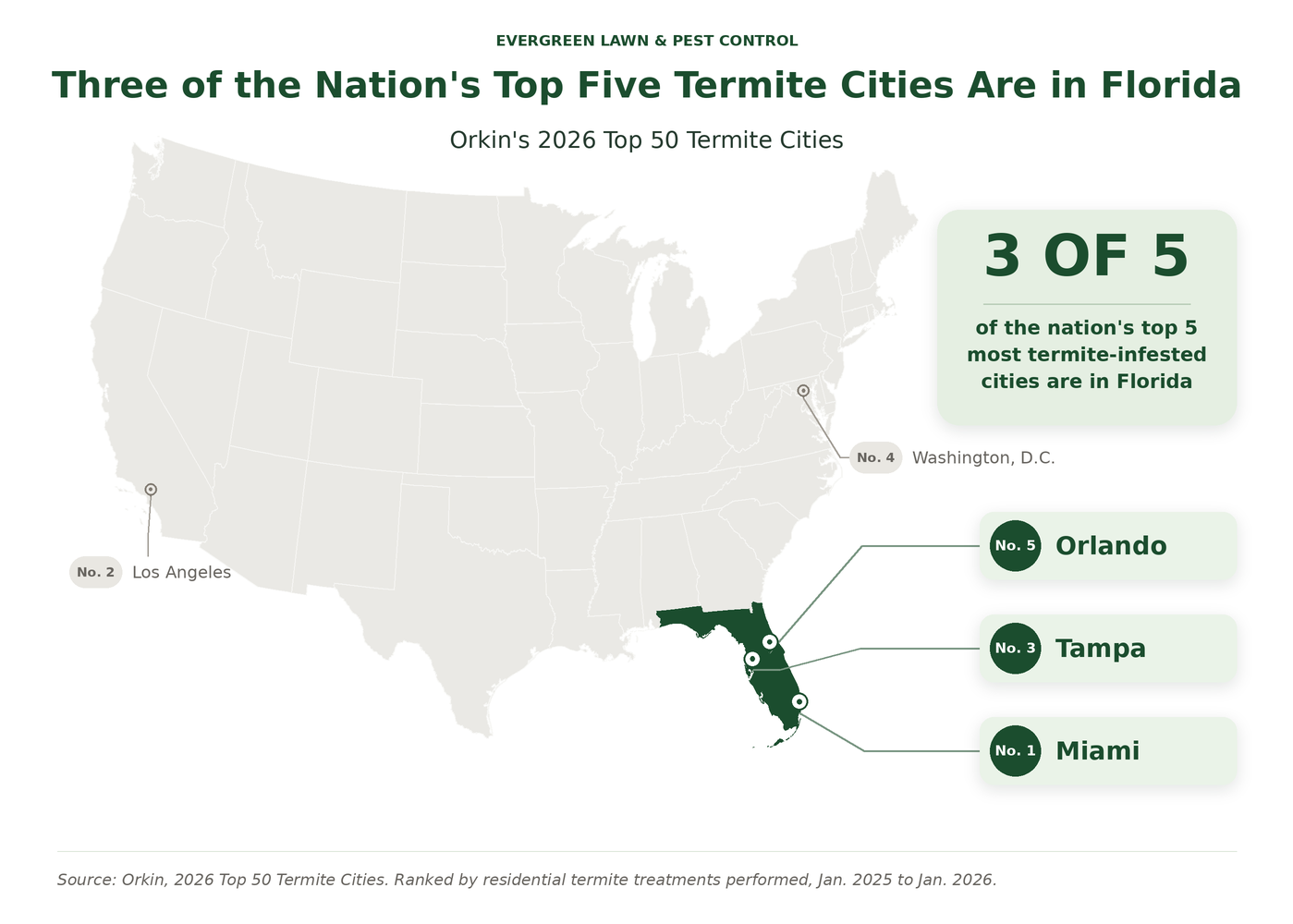
Third-party rankings point the same direction. Orkin’s 2026 ranking of the most termite-infested cities in the country places Orlando at No. 5 nationally and Tampa, part of the broader Tampa Bay region that includes Bradenton, at No. 3 (Orkin, 2026). Miami, which anchors the metro area that includes Fort Lauderdale-Broward County, holds the No. 1 spot for the fourth year running. Melbourne and Bradenton don’t appear individually on national city rankings like Orkin’s, which are built around larger metro areas. That reflects how the rankings are compiled, not evidence that termite pressure is lower there.
UF/IFAS reports heavy populations of the West Indian drywood termite in Key West, Fort Lauderdale, Miami, St. Petersburg, and Tampa, and says the greatest U.S. drywood termite losses occur in southern California, peninsular Florida, and Hawaii (UF/IFAS, EENY-79).
The statewide “Very Heavy” classification covers every county in Florida, and Orkin’s 2026 rankings place Miami, Tampa, and Orlando among the country’s five most termite-infested cities (Orkin, 2026).
Common Household Pests: National Data Meets Regional Patterns
Roaches and rodents are the two pests most commonly tracked in national housing data, but “rodents” isn’t one uniform category. Depending on which species is involved, a rodent problem can be more or less critical.
Florida’s dominant rodent pest is the roof rat (Rattus rattus), an invasive species that climbs and nests in attics, palm trees, and shrubbery rather than burrowing at ground level like the Norway rat common up north. It’s also known to carry murine typhus, a disease spread to humans through fleas (University of Florida IFAS, ENY-224). That makes roof rats a different (and in some ways trickier) pest management problem than ground-level rodents, which is worth keeping in mind when comparing rodent data across regions.
About 14 million U.S. housing units reported seeing roaches, and 14.8 million reported seeing rodents, in the past 12 months (U.S. Census Bureau, American Housing Survey, 2019).
Roach sightings are more common in the South, while rodent sightings are more common in the Northeast (U.S. Census Bureau, American Housing Survey, 2019). Miami’s metro area reports one of the lowest rodent-sighting rates of any major U.S. metro. Just because Florida has “more bugs” doesn’t mean it leads the pack for every pest.
Ants in Florida Homes
Most ant species never come indoors. Others build their nests near buildings and forage indoors, and some nest indoors (UF/IFAS, Pests in and around the Southern Home, 2022). The ants below are among those UF/IFAS identified as pests in and around Florida homes.
- White-footed ant (Technomyrmex difficilis): UF/IFAS describes it as “an important pest ant in Florida.” Workers measure 2.5 to 3 mm and are black to brownish-black with yellowish-white feet. Colony estimates range from 8,000 to 3 million individuals, and nearly half of a colony consists of fertile, reproductive females, which lets colonies divide by budding. The ant was first collected in Florida at a Homestead nursery in 1986 and has since been collected in counties on both coasts, from Monroe County north to Alachua and Volusia counties. Nests sit mostly outdoors, in trees, shrubs, and under palm fronds, while foraging trails climb exterior walls and enter attics through soffit vents. Winged forms are released between July and August in South Florida. The species does not bite or sting, and it has not been reported to cause structural damage. In UF/IFAS laboratory tests from 2002 to 2005, baits were the only effective management method (UF/IFAS, EENY-273, 2019).
- Tawny crazy ant (Nylanderia fulva): Workers are medium-sized, under 1/8 inch long. UF/IFAS reports the species in parts of at least 26 counties, as well as other southern states, with colonies of millions of individuals and many queens. The ant does not form mounds. Colonies most often nest in moist spaces in or under leaf litter, stones, branches, trash, and potted plants. It is a nuisance because workers crawl rapidly over people, and UF/IFAS says the ants are known to cause electrical shorts and may damage expensive equipment. A single insecticide spray lasts less than a week, with ants returning after an average of two to three days. UF/IFAS states that relying on a single control tactic will result in failure, and that 100% eradication is not probable where the ant is established, although population suppression is possible (UF/IFAS, ENY-2006, 2023).
- Ghost ant (Tapinoma melanocephalum): One of the smallest pest ants, with workers 1.3 to 1.5 mm long. UF/IFAS considers it one of the most important household ant pests in Florida. Field populations were mostly confined to South Florida as late as 1988, and by 1995 the ant was common across central and southern Florida and had reached major pest status, mostly from Sarasota to Orlando and south. Colonies contain numerous reproducing females. UF/IFAS says new colonies are probably formed by budding, a behavior it associates with some of the most difficult ants to control, including the Argentine ant (UF/IFAS, EENY-310, 2022; UF/IFAS, Pests in and around the Southern Home, 2022).
- Florida carpenter ant (Camponotus floridanus): Workers range from 5.5 to 11 mm, and winged females reach up to 20 mm. Mature colonies may hold several thousand workers, and queenless satellite nests are often found within 20 to 100 feet of a mature nest. Complaints are numerous during the spring swarm season, usually April through June, and winged reproductives fly in the evening or night during the May through November rainy season. Florida carpenter ants do not eat wood, and they will not excavate nesting galleries in sound wood. They hollow out wood already softened by moisture or fungi, and nests are very common under windows and door frames with moisture intrusion. Finding the nest can be difficult, but UF/IFAS says a small amount of insecticidal dust or spray applied directly to the nest is usually successful (UF/IFAS, EENY-272, 2025; UF/IFAS, Pests in and around the Southern Home, 2022).
Red imported fire ants differ from the species above in that they nest in outdoor soil mounds, which UF/IFAS reports are seldom larger than 18 inches in diameter. A mature colony may contain as many as 240,000 workers, with a typical colony around 80,000 (UF/IFAS, EENY-195, 2020). A single fire ant can sting repeatedly (USDA APHIS, 2026), and UF/IFAS reports that reactions range from localized pain and swelling to anaphylactic shock in hypersensitive individuals. After a heavy rain, a colony may move to higher ground or inside homes to escape saturated soil (UF/IFAS, EENY-195, 2020). APHIS reports that imported fire ants infest more than 367 million acres across 13 states and Puerto Rico, including Florida, and federal quarantines regulate the movement of nursery stock, hay, and soil-moving equipment out of affected areas (USDA APHIS, 2026).
Ant control is difficult because ants are social insects, so treatment has to reach the colony. UF/IFAS describes treatments that target individual trails, such as crack-and-crevice and indoor space-and-surface applications, as usually a “quick fix” that is ineffective in the long term because it does not significantly reduce the ant population or affect the queen. Finding the nest is the key to control, because if it isn’t found, large numbers of individual ants can be killed without ever solving the problem. Baits are effective because they kill the queens as well as the foraging workers, so no new ants are produced. Bait preference can change, and switching from a sugar-based bait to a protein- or oil-based bait may be necessary to keep the ants feeding. Carpenter ants are the exception on baits. UF/IFAS says they are finicky eaters that tend not to recruit in large numbers to any food source, which reduces bait efficacy (UF/IFAS, Pests in and around the Southern Home, 2022; UF/IFAS, EENY-272, 2025).
Mosquito Activity and Disease Risk
Mosquitoes are a public health concern first and a nuisance second. Which species is active matters more than how many there are. Dengue viruses are spread to people by two Aedes species, Aedes aegypti and Aedes albopictus (CDC, 2025). Both live in many areas of the United States, their eggs can survive winter in the southern U.S., and they need only a small amount of water to breed, in containers such as bowls, flowerpots, tires, and barrels (CDC, 2024).
The Florida Department of Health publishes weekly arbovirus surveillance reports that track mosquito-borne viruses including West Nile virus, Eastern equine encephalitis, St. Louis encephalitis, and dengue, using human case counts alongside non-human indicators such as sentinel chickens and mosquito pools. As of the week ending October 24, 2026, the state had recorded 485 locally acquired dengue cases across twelve counties, with cases still being confirmed weekly (Florida Department of Health, Arbovirus Surveillance Report, Week 42, 2026).
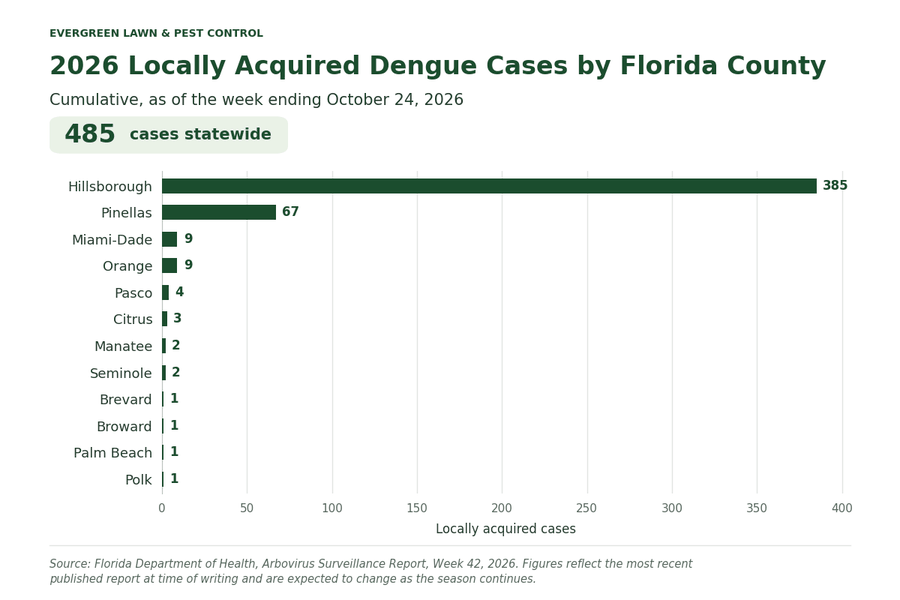
2026’s local dengue transmission has been concentrated in the Tampa Bay area. Hillsborough County, home to Tampa, accounts for 385 of the 485 cases, about 79% of the statewide total, and neighboring Pinellas County accounts for another 67. Together the two counties make up 452 cases, about 93% of the total. Miami-Dade and Orange County, home to Orlando, have each reported 9 cases this year (Florida Department of Health, Arbovirus Surveillance Report, Week 42, 2026).
Manatee County (Bradenton) has reported 2 cases and Broward County (Fort Lauderdale) 1. Those counts are small, but 60 of the 485 cases were reported in the most recent week alone, so county totals can change quickly.
Florida also saw a rare public health event in 2023: seven locally acquired malaria cases, clustered within a four-mile radius in Sarasota County (the first locally acquired malaria transmission reported in the U.S. in two decades) (CDC Health Alert Network, 2023).
What Pest Control Costs
Pest control pricing varies considerably depending on the pest involved, with termite service sitting well above routine pest visits.
What drives pest control cost is mostly the treatment method and how many visits a problem takes to resolve, not the pest itself. A localized pest problem may often take one technician visit and a targeted treatment. Ants are often an exception, because treatment has to reach the nest and queen, not only the foragers. Termite work is different: it requires a full inspection, accurate identification of the species involved (since subterranean and drywood termites call for different treatment protocols), and either a liquid soil barrier or a monitored bait system that can take months to fully resolve. That difference is exactly what shows up in the price gap between categories below.
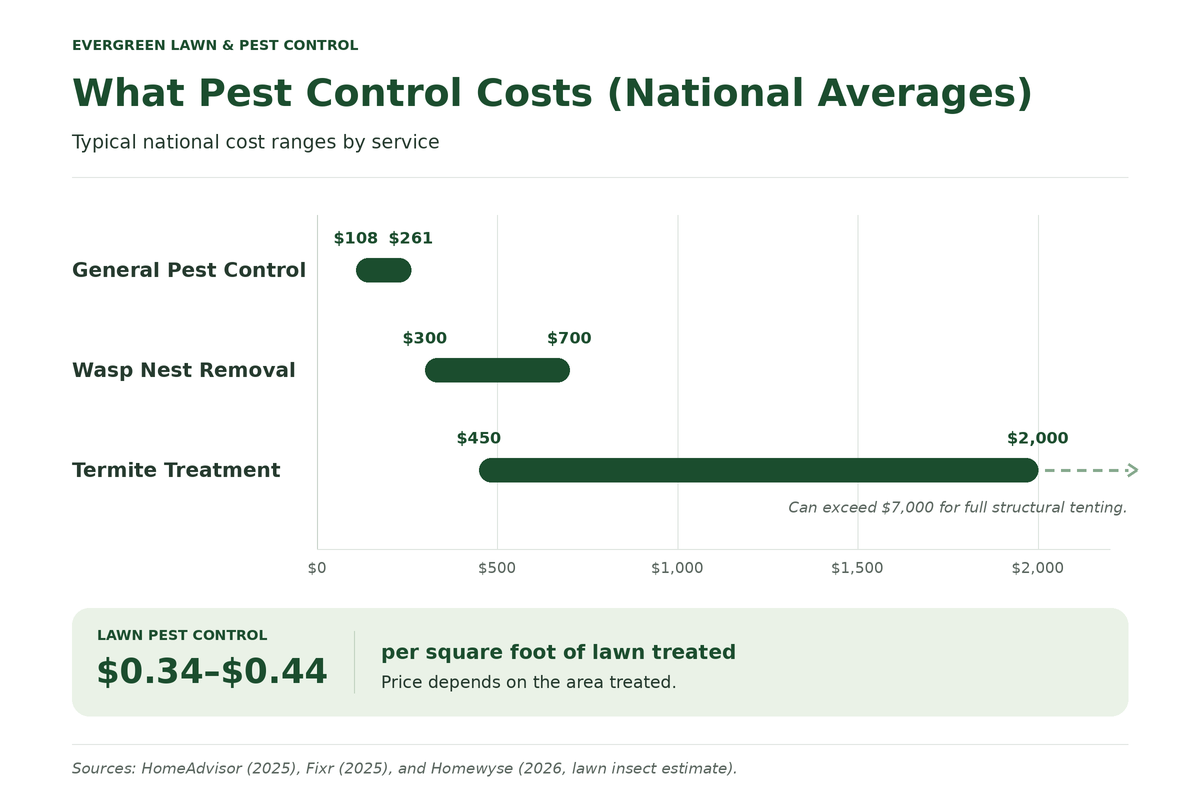
- Nationally, a single pest control visit averages between $108 and $261, with a broader range of $50 to $500 depending on the pest and treatment method (HomeAdvisor, 2025).
- Severity drives most of the price difference: Mild pest problems typically run $100–$500, moderate infestations run $300–$700, and severe, established infestations can run $1,000–$8,000 depending on the pest and the extent of the damage (HomeAdvisor, 2025).
Termite Treatment Cost
Nationally, termite treatment averages around $680 per service, with most homeowners paying between $450 and $2,000 depending on treatment method and severity, and costs reaching as high as $7,000 or more for a full structural tenting job (Fixr, 2025).
Wasp Nest Removal Cost
Wasp nest removal averages around $525 nationally, with most jobs falling between $300 and $700, and the full range running from about $100 for a simple surface nest to $1,300 or more for a large or hard-to-reach colony (HomeAdvisor, 2025).
Lawn Pest Control Cost
Lawn pest treatment, covering chinch bugs, grubs, and other turf-damaging insects, is typically priced per square foot rather than as a flat fee, running about $0.34 to $0.44 per square foot of lawn treated (Homewyse, 2026), meaning total cost depends heavily on the size of the property being treated.
These national figures are a starting point. Actual pricing depends on home size, pest severity, treatment method, and local market conditions.
Pest Control Trends to Watch in 2026
Taken together, regional patterns and the national data on termites, mosquitoes, and household pests point toward a few consistent themes rather than one single narrative. Invasive species continue to establish and spread rather than plateau, and pest pressure keeps sorting itself along fairly predictable lines: geography, climate, and construction style, more than any single national trend. With that framing in mind, here's what stands out heading into the rest of 2026:
- Invasive termite species are spreading farther than predicted: A February 2026 University of Florida study found the Formosan and Asian subterranean termites have spread well beyond South Florida. Researchers expect the Asian species in all 24 of Florida’s southernmost counties before 2040 and the Formosan species statewide before 2050 (UF News, 2026; Chouvenc et al., Journal of Economic Entomology, 2026).
- Termite risk remains a year-round concern in high-risk states: Florida’s statewide “Very Heavy” classification applies across the whole state, subterranean termite colonies in Florida feed on wood year-long (UF/IFAS, EENY-212), and with $6.8 billion in annual national termite damage and standard homeowners insurance almost universally excluding it, proactive inspection continues to carry more financial weight than reactive treatment (NPMA, 2026).
- Roaches show up more often in the South, rodents in the Northeast: Census housing data shows roach sightings concentrated in the South and rodent sightings in the Northeast (U.S. Census Bureau, American Housing Survey, 2019).
- Red imported fire ants remain a fixed, federally regulated problem in the South: These ants infest 367+ million acres across 13 states and Puerto Rico, including Florida (USDA APHIS, 2026).
- Dengue activity is concentrated around Tampa Bay: Florida has recorded 485 locally acquired cases as of late October, 385 of them in Hillsborough County and 67 in Pinellas County (Florida Department of Health, Arbovirus Surveillance Report, Week 42, 2026).
- Regional variation within a single state is significant: How much termite activity a market sees varies enough within Florida alone that state-level or national averages can understate what’s happening in any one city.
- Ants are a control problem more than a damage problem: Several Florida pest ants form colonies of thousands to millions of individuals or spread by budding, so treating visible trails rarely resolves an infestation (UF/IFAS, EENY-273; ENY-2006; EENY-310).
Pest risk in 2026 is best understood regionally rather than nationally: soil, climate, and construction style shape which pests take hold in a given area far more than any single countrywide growth figure or industry-wide trend. A homeowner's actual risk has less to do with the national numbers above and more to do with which state, and even which city, they live in.
Frequently Asked Questions
Which household pests are the biggest concern in Florida?
Termites are Florida’s biggest structural concern. Roaches and ants are the other household pests worth planning for, and several Florida ant species, including the white-footed ant and tawny crazy ant, are hard to control once established. UF/IFAS reports that established subterranean termite colonies in Florida feed on wood year-long. National housing survey data also shows roaches are more common in the South than in any other U.S. region. Florida’s roof rat population is a concern too, since the species can carry murine typhus. Independent sources don’t publish a Florida-specific ranking of which pests homeowners see most often.
Why does Florida have so many bugs?
Florida’s warm, humid climate supports a great diversity of insects and other arthropods. Human activity adds to it: Florida has heavy interstate and international travel, and its economy supports businesses that import pets, fruits, vegetables, and live plants, which creates many opportunities for new species to arrive. UF/IFAS entomologists say that, on average, one new arthropod pest becomes established in the state each month (UF/IFAS, 2014).
Does Florida have a cockroach problem?
Yes, relative to much of the rest of the country. National housing survey data shows roach sightings are more common in Southern states than in any other U.S. region. The survey doesn’t break out Florida on its own, so that comparison is regional, not state-specific.
Why are ants so hard to get rid of in Florida?
Ants are social insects, and spraying trails or treating cracks and crevices usually does not reach the queen. UF/IFAS says finding the nest is the key to control, and that baits work because workers carry them back and kill the queens. Several Florida species, including the white-footed ant and the tawny crazy ant, form very large colonies, so control has to reach the nest rather than the foragers.
How much does pest control cost in Florida?
Pricing depends heavily on the pest and severity. Nationally, a single pest control visit typically runs $108 to $261, with severe infestations costing significantly more. Termite treatment nationally averages around $680. Wasp nest removal averages around $525, and lawn pest treatment is typically priced by square footage rather than as a flat rate.
Methodology
The national and industry-wide statistics in this article come from third-party sources cited inline and in the Sources section below, with the year of publication noted for each. That includes national pest-sighting data from the U.S. Census Bureau’s American Housing Survey, termite risk classifications, national cost ranges, and third-party city and regional rankings such as Orkin’s annual termite city list.
The Florida-specific figures come from public sources too. Dengue case counts come from the Florida Department of Health’s weekly arbovirus surveillance reports and reflect the most recent published report. Florida metro termite rankings come from Orkin’s published rankings.
Given how quickly some of the public health figures on this page can change, particularly dengue case counts during an active season, this page will be refreshed periodically as more data becomes available, and the mosquito-borne disease figures in particular may lag the most current state reporting by several weeks.
Sources
- National Pest Management Association, via PestWorld.org
- USDA Forest Service Termite Infestation Probability Map
- UF/IFAS Entomology & Nematology Department, Why Are There So Many Species of Bugs in Florida? (May 6, 2014)
- University of Florida IFAS, EENY-212: Native Subterranean Termites
- UF News, New study shows invasive termites threatening homes in Florida are spreading farther than predicted (Feb. 4, 2026)
- Chouvenc, T., Ongoing monitoring of the spread of 2 invasive subterranean termite species (Coptotermes Wasmann) in Florida (1990 to 2025), Journal of Economic Entomology (2026)
- University of Florida IFAS, ENY-224: Rat and Mouse Control
- U.S. Census Bureau, American Housing Survey (HUD)
- Florida Department of Health, Arbovirus Surveillance Report, Week 42, 2026
- Centers for Disease Control and Prevention (CDC), Dengue Transmission
- Centers for Disease Control and Prevention (CDC), Life Cycle of Aedes Mosquitoes
- CDC Health Alert Network, Locally Acquired Malaria Cases: Florida, Texas, and Maryland (2023)
- USDA Animal and Plant Health Inspection Service (APHIS), Imported Fire Ants
- University of Florida IFAS, EENY-273: White-Footed Ant, Technomyrmex difficilis
- University of Florida IFAS, ENY-2006: Integrated Pest Management (IPM) of the Tawny Crazy Ant, Nylanderia fulva
- University of Florida IFAS, EENY-310: Ghost Ant, Tapinoma melanocephalum
- University of Florida IFAS, EENY-272: Florida Carpenter Ant, Camponotus floridanus
- University of Florida IFAS, EENY-195: Red Imported Fire Ant, Solenopsis invicta
- University of Florida IFAS, Pests in and Around the Southern Home: Ants
- University of Florida IFAS, EENY-79: West Indian Drywood Termite, Cryptotermes brevis
- HomeAdvisor, Pest Control Cost Guide
- Orkin, 2026 Top 50 Termite Cities
- HomeAdvisor, Hornet & Wasp Nest Removal Cost Guide
- Fixr, Termite Treatment Cost Guide
- Homewyse, Cost to Treat Lawn Insects